


Services
Various services provided by the University Library are listed below:



Research
The university advances knowledge through dedicated research teams in various departments, institutes, and centers, spanning arts, science, technology, and other key areas. We maintain a centralized database system to manage research information and publications efficiently.
Additionally, our university promotes interdisciplinary collaboration among faculty and students to drive innovative research across diverse academic fields, fostering an environment where knowledge and expertise from various disciplines converge to address complex global challenges.


News & Events
Stay Engaged: Dive into Our Library News & Events.
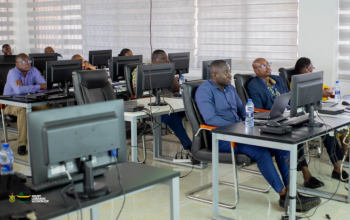
KNUST Library Senior Management Trained in Microsoft 365 to Boost Digital Productivity
Senior management staff of the Kwame Nkrumah University of Science and Technology, Kumasi (KNUST) Library have undergone training in Microsoft 365 to strengthen digital productivity and service delivery. The training forms part of a broader capacity-building initiative aimed at improving collaboration, workflow efficiency and the use of digital tools across the library system. Opening the session, Library Registrar Ms. Felicia Amankwah, who spearheaded the initiative, described the programme as “the long-awaited” first phase of a three-part training series designed to enhance staff skills, engagement and knowledge in essential digital platforms used in their daily operations. She urged participants to actively engage in the sessions and adhere to basic training protocols, including accessing programme materials via a QR code. Lead facilitator Mr. Caleb Tweneboah provided an overview of Microsoft 365 as a subscription-based suite of productivity tools, including Outlook, Teams, Word, Excel, PowerPoint, OneNote, Stream, SharePoint and OneDrive. He highlighted its cloud-based capabilities, which enable users to access documents remotely, receive automatic updates and collaborate in real time. He said the platform offers flexibility in managing storage and user access, while enhancing seamless communication and document sharing across teams. A significant component of the training focused on digital security, with participants taken through practical steps to safeguard personal and institutional data. Mr. Tweneboah demonstrated how to identify phishing attempts and suspicious email formats, cautioning staff against malicious senders who mimic legitimate addresses. Participants also engaged in hands-on demonstrations of Outlook and Teams, with practical guidance on how the tools can be used to streamline communication and coordination within the library. The training is expected to continue with additional sessions under the three-phase programme, as the KNUST Library intensifies efforts to leverage digital technologies to improve operational efficiency and service delivery.
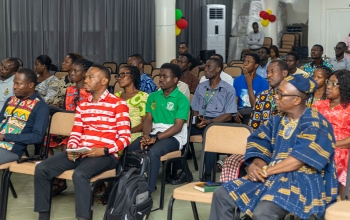
KNUST Library Launches ‘ScienceFriday’ Series Initiative to Promote Scientific Dialogue
The Library System of the Kwame Nkrumah University of Science and Technology, Kumasi (KNUST) has launched a new academic engagement platform known as ‘ScienceFriday’, aimed at encouraging scientific discussion, research sharing and interdisciplinary collaboration within the university community. The initiative brought together students, researchers, faculty members and library staff to explore scientific ideas and emerging research. University Librarian, Dr. Richard Bruce Lamptey, welcomed participants and highlighted the importance of making science accessible to everyone. “Science is a very powerful thing,” he said. “If you are not careful, you will think that it is only for clever students or those with very sharp brains. This programme is going to demystify science and mathematics and many of the things we think are difficult about science.” He emphasised the evolving role of academic libraries, describing them as active partners in the research and innovation process. “The KNUST Library System, as the intellectual hub of the University, is committed not only to providing access to information resources but also to supporting the entire research life cycle, from discovery of information to knowledge creation and dissemination,” he said. He also commended library staff and other university personnel for their efforts in organising the programme, noting that their dedication demonstrates the continuing importance of libraries in fostering academic dialogue. Dr. Cyril Dziedzorm Boateng, a Senior Lecturer in the Department of Physics, delivered a presentation exploring how modern geophysical techniques, including drones and ground-penetrating radar, were used to uncover historical artefacts at a long-lost 18th-century fort in Ghana’s Central Region. He also highlighted a key challenge faced by Europeans when constructing coastal forts: access to fresh water. “Since Europeans could not drink seawater, they had to create underground cisterns, either carved directly from rock or constructed using bricks brought on their ships,” Dr. Boateng said. He encouraged students to visit the exhibition at the KNUST Museum, where artefacts, photographs, maps and scientific results from the project are currently on display. “When you see the exhibition, you will understand the full story,” he said. “It will help you appreciate how science connects to our history.” Dr. Boateng also advised students not to limit themselves to only their fields of study. “Do not box yourself in,” he said. “Be open to learning. Be curious. Science is everywhere.”
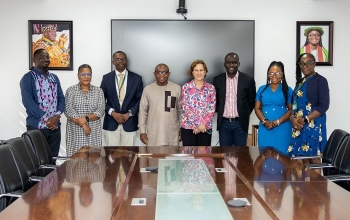
KNUST, Book Aid International Discuss Partnership Opportunities to Boost Medical Library Collections
The Kwame Nkrumah University of Science and Technology, Kumasi (KNUST) and Book Aid International are initiating discussions on a potential partnership aimed at strengthening donation of medical and health sciences resources at the University’s library. The Chief Executive of Book Aid International, Alison Tweed, said their visit to KNUST was to assess opportunities to support KNUST with up-to-date medical textbooks and reference materials. ‘‘We are here to discuss possibility of donating medical books to the KNUST library,’’ she said. Alison explained that the organization works closely with leading global publishers, noting that its primary medical donor is Elsevier, alongside contributions from SAGE Publications, Oxford University Press, Cambridge University Press, and Pearson. “In an average year, we distribute about 80,000 medical books to partners across Africa, including teaching hospitals, university departments, and health training institutions,” the representative stated. “Our visit to KNUST is to understand your acquisition strategies and explore how we can work together to supply relevant medical books for your collections.” She emphasized their organization’s commitment to quality and relevance, indicating that donated books are typically no more than five years old and largely consist of new titles. The organization also highlighted its tailored selection approach, which is guided by needs assessment forms completed by partner institutions. “We pride ourselves on listening closely to our partners’ requirements,” Alison added. “Whether it is nursing, midwifery, orthopaedics, or other specialisms, our goal is to ensure the books we send are aligned with institutional priorities.” Dr Bruce Lamptey, University Librarian, outlined the University’s collection development strategy, explaining that academic resources are centrally procured and distributed across colleges, with additional subject-specific acquisitions undertaken at the college level. The Provost of the College of Health Sciences, Professor Christian Agyare welcomed the initiative, describing access to current medical literature as critical for teaching, learning, and research. Discussions also addressed logistical considerations, particularly customs clearance and associated charges.
13
March 2026Science Friday
1:00 PMPREMPEH II LIBRARY
2
August 2023Elsevier Workshop
10:00 AMOnline