All news
25th-Apr-2026
Science Friday, Episode 3: Vision Revolution : The Science behind better eye care

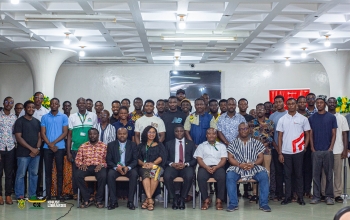
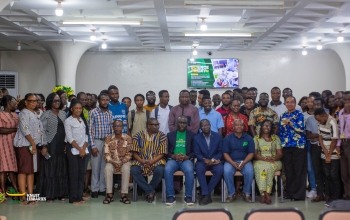
Dr. Kwadwo Owusu Akuffo, Senior Lecturer at the Department of Optometry and Visual Science, has raised concern over the rising cases of Computer Vision Syndrome (CVS) among young people and professionals, warning that prolonged screen use is quietly straining the eyes of many Ghanaians. Speaking at the third edition of Science Friday, an academic engagement platform organised by KNUST Libraries to promote scientific discussion, research sharing, and interdisciplinary collaboration, he addressed the theme “Vision Revolution: The Science Behind Better Eye Care.” “Computer Vision Syndrome is a group of eye and vision problems resulting from prolonged screen use. When we stare at screens for long periods, our blink rate reduces, leading to dry eyes. At the same time, continuous near focus causes fatigue, while glare and poor posture increase visual stress,” he explained. He noted that common symptoms include eye strain, dryness, irritation, blurred vision, headaches, and even neck and shoulder pain, conditions many people often ignore until they worsen. To curb the condition, Dr. Owusu Akuffo emphasized simple but effective preventive measures, particularly the 20-20-20 rule, which involves looking away from the screen every 20 minutes at something 20 feet away for at least 20 seconds. “Keep your screen at a distance of about 50 to 70 centimetres and position it slightly below eye level. Blink more often, ensure proper lighting, and use the right prescription glasses where necessary,” he advised. Beyond digital eye strain, he highlighted the broader challenge of preventable vision loss, revealing that nearly 90% of vision problems can be avoided with early detection and proper care. Dr. Owusu Akuffo also spotlighted the role of the KNUST Low Vision Centre, which provides specialized assessments and assistive devices such as magnifiers and electronic aids for individuals with irreversible vision loss, while training eye care professionals across the country. He urged the public to adopt healthy eye care habits, including regular eye examinations, wearing UV-protective sunglasses, and maintaining a balanced diet rich in vitamins A, C, and E. He called on Ghanaians to prioritize routine eye checks and proactive care to prevent avoidable vision loss. “If you close your eyes for a minute, you will begin to imagine the life many people live in darkness and blindness,’’ he said.

25th-Apr-2026
Book Aid International Donates Books to Support KNUST Library Expansion

The Kwame Nkrumah University of Science and Technology, Kumasi (KNUST) Library has received a new consignment of books from Book Aid International to enrich its collections, facilitated by former University Librarian, Dr. Helena Asamoah-Hassan. Dr. Helena Asamoah-Hassan.The initiative was described as a continuation of her longstanding commitment to literacy development and library outreach. Dr Asamoah-Hassan explained that the donation forms part of an ongoing partnership with Book Aid International, aimed at providing quality books to children’s libraries, secondary schools and selected tertiary institutions across the country. “When I learned that the children’s libraries at KNUST were reopening, I felt it was important to include them in our next distribution. I’m praying that as new consignments arrive, the KNUST Library will always be kept in mind,” she said. Dr Asamoah-Hassan added that similar donations have benefited children’s hospitals and community libraries, reinforcing her belief that access to reading materials is central to education and social development. After serving KNUST for 14 years, she said returning to contribute again felt deeply meaningful. “I’m happy to be back and to support the office I once sat in,” she said. University Librarian, Dr. Richard Bruce Lamptey.The University Librarian, Dr. Richard Bruce Lamptey, expressed appreciation for Dr Asamoah-Hassan’s leadership. “We are very happy that she is here to support us and register the new books,” he said.

18th-Apr-2026
Science Friday Episode 2 : Deadlines Are Temporary, Your Health Is Not, KNUST Lecturer Calls for Balance

 Published: 10th Apr 2026   Dr. (Mrs.) Mary Amoako, Senior Lecturer at the Department of Biochemistry and Biotechnology at Kwame Nkrumah University of Science and Technology (KNUST), has urged students and staff to prioritise their health over academic and work pressures, warning that unmanaged stress can have serious physiological and psychological consequences. Speaking at the second edition of the ScienceFriday Series organised by the KNUST Library System, Dr. Amoako emphasised that while deadlines are inevitable in academic environments, health must remain a top priority. “Deadlines are temporary, your health is not,” she stressed. Dr. Amoako explained that stress triggers the release of cortisol, a hormone that, when persistently elevated, can negatively affect the body. According to her, high cortisol levels influence eating behaviours by disrupting hunger-regulating hormones such as ghrelin and leptin. She noted that individuals respond differently to stress. “There are some individuals who will undereat because they are stressed, others will overeat and crave fatty and sugary foods, while some develop irregular eating patterns,” she explained. She highlighted findings from several cross-sectional studies that reveal troubling trends among university students. One study involving 180 students across various colleges found that over 60 percent had limited access to food, with about two-thirds lacking sufficient meals, a situation she said has direct implications for mental health. Another study cited from her studies indicated that students experiencing high levels of stress recorded higher blood pressure compared to their less-stressed counterparts. A third study comparing teaching and non-teaching staff also revealed significant stress-related health patterns. Dr. Amoako outlined common behavioural signs of stress, including fatigue, headaches, anxiety, poor concentration, appetite changes, and feelings of being overwhelmed. To address these challenges, she encouraged practical lifestyle adjustments. “Fix your sleep and wake-up times, plan your day and your meals, engage in regular physical activity, and most importantly, address the root cause of your stress,” she advised She also urged students and staff to seek early support, pointing to the availability of wellness and counselling services on campus. On nutrition, Dr. Amoako advised individuals to prioritise whole foods, including whole grains, fruits, vegetables, healthy proteins, and oils, while staying well hydrated, especially during stressful periods. “Stress has the potency of affecting behaviour, especially eating habits, and this varies from person to person,” she added.  University Librarian, Dr. Richard Bruce Lamptey The University Librarian, Dr. Richard Bruce Lamptey, noted that the Science Friday Series is designed to promote the wellbeing of both staff and students. “Our aim is not only to meet targets but also to prevent situations where we sacrifice our health in the process,” he said. He described the theme of the session as timely and relevant in a fast-paced academic environment where pressure often leads to neglect of personal wellbeing. “Success is not measured only by deadlines met, papers submitted, or projects completed, but also by the wellbeing we preserve along the way,” he said. He called on the university community to consciously balance productivity with wellness to ensure sustainable success.

24th-Mar-2026
KNUST Library Senior Management Trained in Microsoft 365 to Boost Digital Productivity

  Senior management staff of the Kwame Nkrumah University of Science and Technology, Kumasi (KNUST) Library have undergone training in Microsoft 365 to strengthen digital productivity and service delivery. The training forms part of a broader capacity-building initiative aimed at improving collaboration, workflow efficiency and the use of digital tools across the library system. Opening the session, Library Registrar Ms. Felicia Amankwah, who spearheaded the initiative, described the programme as “the long-awaited” first phase of a three-part training series designed to enhance staff skills, engagement and knowledge in essential digital platforms used in their daily operations. She urged participants to actively engage in the sessions and adhere to basic training protocols, including accessing programme materials via a QR code. Lead facilitator Mr. Caleb Tweneboah provided an overview of Microsoft 365 as a subscription-based suite of productivity tools, including Outlook, Teams, Word, Excel, PowerPoint, OneNote, Stream, SharePoint and OneDrive. He highlighted its cloud-based capabilities, which enable users to access documents remotely, receive automatic updates and collaborate in real time. He said the platform offers flexibility in managing storage and user access, while enhancing seamless communication and document sharing across teams. A significant component of the training focused on digital security, with participants taken through practical steps to safeguard personal and institutional data. Mr. Tweneboah demonstrated how to identify phishing attempts and suspicious email formats, cautioning staff against malicious senders who mimic legitimate addresses. Participants also engaged in hands-on demonstrations of Outlook and Teams, with practical guidance on how the tools can be used to streamline communication and coordination within the library. The training is expected to continue with additional sessions under the three-phase programme, as the KNUST Library intensifies efforts to leverage digital technologies to improve operational efficiency and service delivery.

14th-Mar-2026
KNUST Library Launches ‘ScienceFriday’ Series Initiative to Promote Scientific Dialogue

The Library System of the Kwame Nkrumah University of Science and Technology, Kumasi (KNUST) has launched a new academic engagement platform known as ‘ScienceFriday’, aimed at encouraging scientific discussion, research sharing and interdisciplinary collaboration within the university community. The initiative brought together students, researchers, faculty members and library staff to explore scientific ideas and emerging research. University Librarian, Dr. Richard Bruce Lamptey, welcomed participants and highlighted the importance of making science accessible to everyone. “Science is a very powerful thing,” he said. “If you are not careful, you will think that it is only for clever students or those with very sharp brains. This programme is going to demystify science and mathematics and many of the things we think are difficult about science.” He emphasised the evolving role of academic libraries, describing them as active partners in the research and innovation process. “The KNUST Library System, as the intellectual hub of the University, is committed not only to providing access to information resources but also to supporting the entire research life cycle, from discovery of information to knowledge creation and dissemination,” he said. He also commended library staff and other university personnel for their efforts in organising the programme, noting that their dedication demonstrates the continuing importance of libraries in fostering academic dialogue. Dr. Cyril Dziedzorm Boateng, a Senior Lecturer in the Department of Physics, delivered a presentation exploring how modern geophysical techniques, including drones and ground-penetrating radar, were used to uncover historical artefacts at a long-lost 18th-century fort in Ghana’s Central Region. He also highlighted a key challenge faced by Europeans when constructing coastal forts: access to fresh water. “Since Europeans could not drink seawater, they had to create underground cisterns, either carved directly from rock or constructed using bricks brought on their ships,” Dr. Boateng said. He encouraged students to visit the exhibition at the KNUST Museum, where artefacts, photographs, maps and scientific results from the project are currently on display. “When you see the exhibition, you will understand the full story,” he said. “It will help you appreciate how science connects to our history.” Dr. Boateng also advised students not to limit themselves to only their fields of study. “Do not box yourself in,” he said. “Be open to learning. Be curious. Science is everywhere.”

25th-Feb-2026
KNUST, Book Aid International Discuss Partnership Opportunities to Boost Medical Library Collections

The Kwame Nkrumah University of Science and Technology, Kumasi (KNUST) and Book Aid International are initiating discussions on a potential partnership aimed at strengthening donation of medical and health sciences resources at the University’s library. The Chief Executive of Book Aid International, Alison Tweed, said their visit to KNUST was to assess opportunities to support KNUST with up-to-date medical textbooks and reference materials. ‘‘We are here to discuss possibility of donating medical books to the KNUST library,’’ she said. Alison explained that the organization works closely with leading global publishers, noting that its primary medical donor is Elsevier, alongside contributions from SAGE Publications, Oxford University Press, Cambridge University Press, and Pearson. “In an average year, we distribute about 80,000 medical books to partners across Africa, including teaching hospitals, university departments, and health training institutions,” the representative stated. “Our visit to KNUST is to understand your acquisition strategies and explore how we can work together to supply relevant medical books for your collections.” She emphasized their organization’s commitment to quality and relevance, indicating that donated books are typically no more than five years old and largely consist of new titles. The organization also highlighted its tailored selection approach, which is guided by needs assessment forms completed by partner institutions. “We pride ourselves on listening closely to our partners’ requirements,” Alison added. “Whether it is nursing, midwifery, orthopaedics, or other specialisms, our goal is to ensure the books we send are aligned with institutional priorities.” Dr Bruce Lamptey, University Librarian, outlined the University’s collection development strategy, explaining that academic resources are centrally procured and distributed across colleges, with additional subject-specific acquisitions undertaken at the college level. The Provost of the College of Health Sciences, Professor Christian Agyare welcomed the initiative, describing access to current medical literature as critical for teaching, learning, and research. Discussions also addressed logistical considerations, particularly customs clearance and associated charges.

11th-Dec-2025
KNUST Library System Welcomes 2025/2026 National Service Personnel

KNUST Library System Welcomes 2025/2026 National Service Personnel   The KNUST Library System officially welcomed its 2025/2026 batch of National Service Personnel on 8th December, 2025, at the Prempeh II Library Building. The orientation brought together newly posted personnel, senior members of the library system, and departmental heads to familiarize the personnel with the operations and expectations of the system. The session was opened by the University Librarian, Dr. Richard Bruce Lamptey, who warmly welcomed the new personnel and congratulated them on their posting. In his address, Dr. Lamptey emphasized the importance of professionalism, discipline, teamwork, and a strong desire to learn. He reminded them that the National Service period is a unique opportunity that will add immensely to their knowledge base, especially within an academic environment that thrives on research, innovation, and effective information management. The personnel were later introduced to the various departments within the KNUST Library System. Heads of units explained their roles, highlighted ongoing activities, and described how each department supports the university’s teaching, learning, and research agenda. This guided the personnel to understand the workflows, expectations, and the collaborative nature of library services at KNUST. Dr. Lamptey encouraged them to work hard, noting that the attitude they bring to the role will significantly influence the value they gain from the service year. He urged them to stay committed, ask questions, and embrace the learning experience fully. The orientation concluded with an interactive session where the personnel engaged the facilitators with questions and shared their expectations for the year. The KNUST Library System looks forward to a productive and impactful year with the new National Service Personnel and remains dedicated to fostering a supportive environment for growth and professional development.  

20th-Nov-2025
KNUST Library at Forefront as COPYGHANA and IFRRO Push Collective Licensing for Academic Integrity.

The Kwame Nkrumah University of Science and Technology (KNUST) Library has taken a frontline role in strengthening copyright compliance across Ghana’s tertiary education sector, partnering with the Reproduction Rights Organisation of Ghana (COPYGHANA) and the International Federation of Reproduction Rights Organisations (IFRRO) to train universities on collective licensing and responsible use of academic materials. The event brought together legal scholars, international experts, authors, publishers, librarians and practitioners from copyright bodies including the Copyright Licensing Agency (UK) and the Copyright Clearance Center (US). Participants examined strategies to ensure that creators receive due recognition while supporting the ethical use of educational materials. KNUST University Librarian, Dr. Richard Bruce Lamptey, said copyright compliance is not only a legal mandate but a scholarly responsibility. He emphasised that academic integrity, research sustainability and the economic viability of authors depend on respect for copyright. He noted that KNUST plays a “dual identity” in the copyright ecosystem, both as a major consumer of academic materials and as a producer of knowledge through its researchers, authors and innovators and therefore must uphold strong copyright practices to protect its intellectual community. Acknowledging the complexity of enforcement, he said, “The challenge before us is simple to articulate but difficult to execute.” Justice of the Court of Appeal, Dr. Poku Adusei, addressed the long-standing balance in copyright law between private rights and public access to knowledge. Drawing on jurisprudence from English, American, Canadian and Ghanaian courts, he said copyright must incentivise creativity while avoiding rules that impede cultural progress. “Comparative experience has confirmed that copyright balances two competing interests: the public interest and the private interest,” he stated. He outlined five key lessons for tertiary institutions and cautioned against rampant free-riding on intellectual property, urging respect for fair-dealing principles, institutional responsibility and strict adherence to the law. He concluded, “There is no way out than for our tertiary institutions to respect the laws on copyright.” International copyright expert Olav Stokkmo, consultant to WIPO and IFRRO, presented data showing that only one percent of students pay for the intellectual property they use, despite almost all relying heavily on authors’ works. He said this underscores the urgent need for systems that ensure proper recognition and compensation for creators. The workshop featured two high-level panel discussions. The first, “Copyright Compliance in Ghanaian Universities,” included contributions from Dr. Lucy Afeafa Ry-Kottoh, Richard Obeng Mensah, Ernest Oppong and Dr. Wale Okediran, with an intervention from Sheila Narki Djagmah of the Copyright Office. Panelists discussed measures to build copyright-aware academic environments and reduce infringement on university campuses. A second panel, “Looking Forward: From Digital to AI,” led by James Bennett (CLA, UK) and Victoriano Colodrón (CCC, US), explored copyright implications of rapid digital transformation and artificial intelligence in higher education. Dr. Adusei reiterated that collective licensing remains the most sustainable and efficient mechanism for copyright enforcement in tertiary institutions. He encouraged continued engagement with copyright law as a way of strengthening institutional compliance and safeguarding the intellectual property of creators.

08th-Nov-2025
Speech by the new University Librarian (Dr. Richard Bruce Lamptey), KNUST.

*At the First Meeting with Library Staff* Good morning, distinguished colleagues, It is with deep humility and great enthusiasm that I stand before you today as the new University Librarian of the Kwame Nkrumah University of Science and Technology. I am truly honoured to join this community of dedicated professionals who have worked tirelessly to uphold the reputation and excellence of our University Library — one of the finest in the nation and indeed on the African continent. First and foremost, I wish to express my heartfelt appreciation to my predecessor and to all of you, the hardworking staff, for your unwavering commitment to service, scholarship, and innovation. The successes the KNUST Library has achieved over the years are a testament to your collective effort, creativity, and resilience. As we begin this new chapter together, I see our library not just as a storehouse of knowledge, but as a dynamic centre for learning, research, and collaboration — a place where technology meets tradition, and where ideas can flourish freely. Our mission remains clear: to support teaching, learning, and research by providing timely access to relevant information resources and services. However, the landscape of librarianship is changing rapidly. The digital age presents both challenges and exciting opportunities. We must therefore continue to innovate — embracing digital transformation, strengthening our information literacy programmes, expanding access to electronic resources, and ensuring that our spaces remain vibrant, inclusive, and user-centred. I believe strongly in teamwork and open communication. Each one of you — from the senior librarian to the newest assistant — plays an integral role in the success of this institution. Your insights, creativity, and passion will guide our collective journey forward. My leadership philosophy is rooted in collaboration, transparency, and mutual respect. I encourage us all to share ideas, ask questions, and work together as one strong KNUST Library family. In the coming weeks, I will be meeting with various sections and units to learn more about your work, challenges, and aspirations. Together, we will develop a shared vision and a strategic plan that aligns with the broader goals of the university — a plan that will position KNUST Library as a model of excellence in academic librarianship across Africa. Let us approach this journey with renewed energy, a spirit of innovation, and an unwavering commitment to excellence. The future of the KNUST Library is bright — and together, we will make it even brighter. Thank you, and I look forward to working closely with each of you. *Ayekoo, and may we continue to uphold the proud tradition of KNUST — *“Nyansapo wosane no badwen ba” — “The knot of wisdom is untied by the wise.”

05th-Nov-2025
Dr. Richard Bruce Lamptey has officially assumed duty as the new University Librarian of the Kwame Nkrumah University of Science and Technology (KNUST), Kumasi.

Dr. Richard Bruce Lamptey has officially assumed duty as the new University Librarian of the Kwame Nkrumah University of Science and Technology (KNUST), Kumasi, pledging to lead with collaboration, innovation, and openness as the library embraces digital transformation. Addressing staff at his first engagement meeting, Dr. Lamptey said he was “deeply honoured” to join a community of dedicated professionals whose work has sustained one of the nation’s most respected academic libraries. “It is with deep humility and great enthusiasm that I stand before you today as the new University Librarian,” he said. “I am truly honoured to join this community of dedicated professionals who have worked tirelessly to uphold the reputation and excellence of our University Library, one of the finest in the nation and indeed on the African continent.” He expressed appreciation to his predecessor, Dr. Samuel Kotei Nikoi, and commended all staff for their “unwavering commitment to service, scholarship, and innovation.” “Our library is not just a storehouse of knowledge but a dynamic centre for learning, research, and collaboration; a place where technology meets tradition, and where ideas can flourish freely,” Dr. Lamptey remarked. “Our mission remains clear: to support teaching, learning, and research by providing timely access to relevant information resources and services.” Emphasising the rapidly changing landscape of librarianship, he called on staff to embrace digital tools and innovation. “The digital age presents both challenges and exciting opportunities. We must therefore continue to innovate by strengthening information literacy, expanding access to electronic resources, and ensuring our spaces remain vibrant, inclusive, and user-centred,” he said. Dr. Lamptey reaffirmed his commitment to teamwork and transparent leadership. “Each one of you, from the senior librarian to the newest assistant, plays an integral role in our success. My leadership philosophy is rooted in collaboration, transparency, and mutual respect,” he noted. “Let us share ideas, ask questions, and work together as one strong KNUST Library family.” He announced plans to meet various library sections in the coming weeks to discuss their work, challenges, and aspirations toward developing a shared strategic plan aligned with the university’s vision. “Together, we will position KNUST Library as a model of excellence in academic librarianship across Africa,” he said. “The future of the KNUST Library is bright, and together, we will make it even brighter.” The session also introduced Mrs. Felicia Amankwah, the new Senior Assistant Registrar, who succeeds Mrs. Janet Ampah, and Dr. Edward Mensah Borteye, who assumes the role of Deputy University Librarian. Both outgoing officers were commended for their dedicated service. Mrs. Amankwah urged staff to “work collaboratively, uphold mutual respect, and maintain open communication in pursuit of excellence,” while reaffirming her commitment to supporting the library’s administrative efficiency.

04th-Nov-2025
A farewell message from Dr. Samuel Nikoi (University Librarian, KNUST. 2016-2025)

Today (31st October, 2025) marks my official day of retirement from Kwame Nkrumah University of Science and Technology. Almost ten (10) years ago, I made the courageous, yet bold, decision to move from the United Kingdom to Ghana to serve my nation as the University Librarian at KNUST.  My decision to relocate to Ghana was driven by my passion for education and learning, in which library services are a vital part. With nearly twenty-five years of experience in librarianship at the time, I observed a troubling mindset both in Ghana and abroad, especially in Africa, where many viewed education as teaching based on indoctrination rather than genuine learning opportunities. This teaching-focused view of education, which prioritises obedience and conformity over questioning, creativity, and innovation, was deeply worrying to me. I was also troubled by a library practice characterized by an obsession with learning resources, mostly imported from Western countries, which often served as decorative items on ornate shelves rather than being actively used or integrated into the educational process. I was eager to collaborate with you and the university management to reshape the narrative and challenge the outdated perceptions of libraries held by many academics, who often view them merely as information repositories. This limited perception of what our noble profession of Librarianship represents, one that has been the cornerstone of prestigious universities like Oxford and Cambridge, was damaging the profession's image, but more critically, it was also harming education and human capital in Ghana. Over the past decade, we have worked diligently, with the support of university management, to transform library practices here at KNUST. Developments in the KNUST learning environment, including specially designed learning spaces to support different learning styles, technology-mediated learning systems, operational service initiatives (such as twenty-four-hour services during peak times), and access to print and digital learning resources, demonstrate what we have collectively achieved. The Library Mall stands as a centrepiece and testament to the new momentum in higher education libraries across Ghana. The Times Higher Education ranking of KNUST as No. 1 for quality education (SDG4) also affirms what we have accomplished together. Going forward, I encourage you all to look positively towards the future and to support the incoming University Librarian, Dr Richard Bruce-Lamptey, in pioneering new developments in the country's educational sector. Richard, like me, is also deeply passionate about the growth of library practice. He is knowledgeable and brings a wealth of experience to the field. Together, you should work to envisage a future filled with hope and transformation for our noble profession. I expect you to confront the habits that hinder the development of our profession. Things can appear differently when we change the way we perceive them. The comfort zone is a beautiful place, but nothing ever grows there. Life is a one-time offer, don’t waste it. Die empty. I am forever grateful to all of you, senior members, senior staff, junior staff, administrative staff, drivers, and cleaners, for making this journey a memorable one. For those of you who opposed some aspects of my vision, I also want to express my gratitude. I learnt a lot from our disagreements, and they helped shape our practice. I leave you with the words of Martin Luther King Jr: “If you can't fly, then run; if you can't run, then walk; if you can't walk, then crawl, but whatever you do, you have to keep moving forward”. I am proud of you all for being noble staff members of a twenty-first-century library service to KNUST. Goodbye, and may the good Lord bless you all.