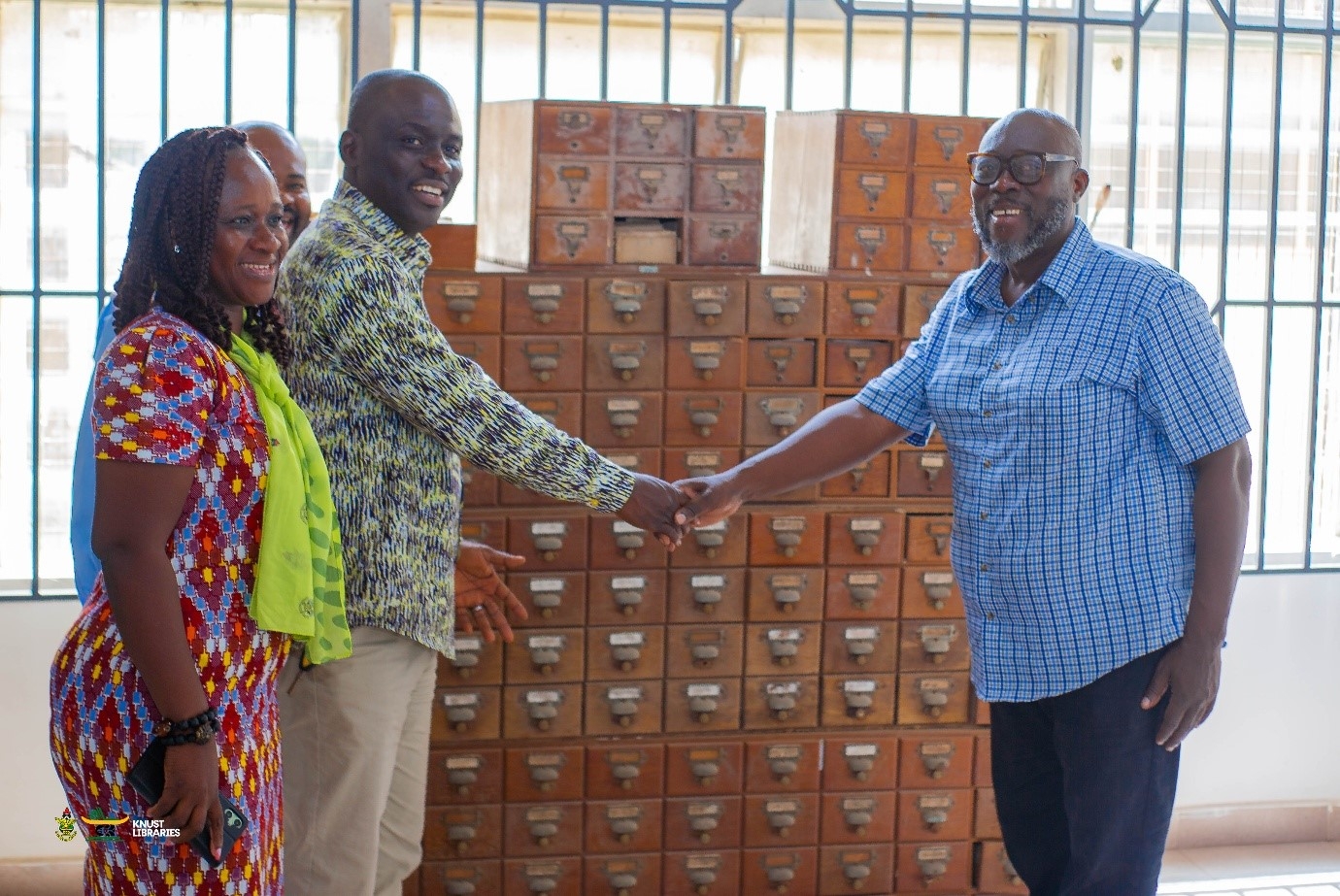
Donation to KNUST MUSEUM
Preserving Heritage: KNUST Library Donates Historic Card Catalogue to the Opoku Ware II Museum
On April 2, 2026, the KNUST Library took a significant step toward preserving its institutional heritage by officially donating its historic physical card catalogue to the Opoku Ware II Museum, KNUST. Once the backbone of information retrieval and knowledge organization on campus, the catalogue has transitioned from an essential academic tool into a treasured historical artifact. Its preservation ensures that future generations can appreciate the evolution of librarianship and the enduring legacy of knowledge management at the university.
The historic handover was conducted by a delegation from the KNUST Library System comprising the University Librarian, Dr. Richard Bruce Lamptey; the Senior Assistant Librarian and Head of the Collection Development and Management (CDM) Unit at the Prempeh II Library, Rev. Dr. Kwabena Ofori Asiamah; and the University Library Administrator, Ms. Vicentia Afeafa Adjandeh. The artifact was received on behalf of the museum by Prof. Edwin Kwesi Bodjawah, Associate Professor and Museum Coordinator.

A Window into the History of Knowledge
The library card catalogue carries a fascinating history that spans both global and local contexts. Internationally, card cataloguing evolved from ancient inventory systems into a standardized card-based method of organizing information during the eighteenth and nineteenth centuries. The concept gained prominence in 1791 when French revolutionaries used playing cards to catalogue collections. It was later refined and standardized by the Library of Congress through the introduction of typed catalogue cards, establishing a global framework for organizing library materials by author, title, and subject.
At KNUST, the donated catalogue dates back to 1961 and reflects the university’s early efforts in information organization, storage, and retrieval. The Kumasi College of Technology Library, established in 1959, initially operated from the Institute of Mining and Mineral Engineering (IMME), located behind the present-day Jubilee Mall in the Commercial Area. Following the library’s relocation to its current site in 1961, a functional catalogue system was urgently developed to facilitate the efficient charging and discharging of books and other library materials.
The Mechanics of an Antique Information System
As a comprehensive and meticulously organized register, the card catalogue served as the primary tool through which users located books, journals, and other resources within the library. Each item in the collection was represented by a detailed 3 × 5-inch bibliographic card containing essential information such as the call number, author, title, and publisher. These cards were systematically arranged in standardized wooden cabinets according to strict alphabetical or subject-based classification schemes.
Depending on institutional preferences, catalogues could be organized as Alphabetical, Classified, or Alphabetico-Classed systems. To maximize accessibility and efficiency, libraries ideally maintained four separate catalogues: Subject, Author, Title, and Class. At one point, KNUST Libraries operated all four systems simultaneously to provide comprehensive access to information for its users.

From Card Drawers to Digital Discovery
The physical card catalogue remained a prominent feature of library operations at KNUST until the turn of the millennium. Its use gradually declined around the year 2000, and by 2005 the wooden cabinets had been officially retired from active service.
The retirement of the catalogue marked the beginning of a major digital transformation within the KNUST Library System. Manual cataloguing processes were first replaced by the Computerised Documentation Service/Integrated Set of Information Systems (CDS-ISIS). This was subsequently succeeded by the Alexandria Library Management System between 2009 and 2010, which introduced the Online Public Access Catalogue (OPAC) and significantly enhanced access to library resources.
In line with evolving technological standards and the growing demands of modern library services, KNUST Libraries is currently preparing to migrate to Koha, a leading open-source integrated library management system that will further strengthen digital access and resource management.

Preserving the Past for Future Generations
Now permanently housed at the Opoku Ware II Museum, the 1961 card catalogue stands as a powerful symbol of KNUST’s journey through the changing landscape of information management. More than a collection of cards and cabinets, it represents decades of scholarly service, innovation, and institutional memory. Its preservation bridges the gap between the ink-and-paper traditions of the past and the dynamic digital future of education and knowledge dissemination.
Photography: Yawson Obed, KNUST Library