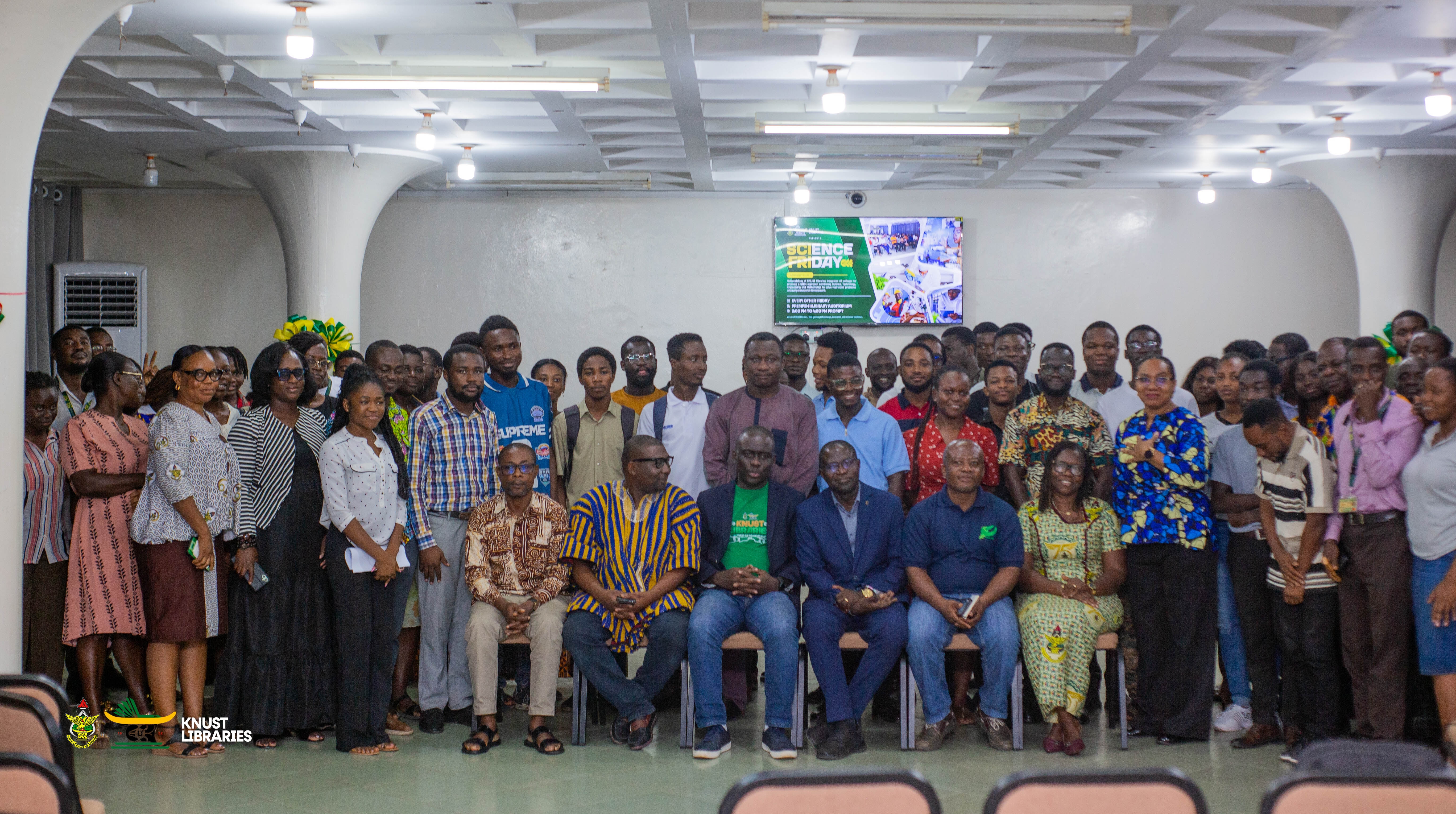
Science Friday, Episode 7 : Listening to Mosquitoes Translating Flight Sounds into Data for Disease Monitoring
Our speaker for the 7th edition of ScienceFriday organized by KNUST Libraries is Prof. Kingsley Badu, an Associate Professor in Theoretical and Applied Biology at KNUST. His research focuses on Bioacoustics, Public Health, Entomology. He took us into the world of mosquito flight sounds and how they could become data for disease monitoring.
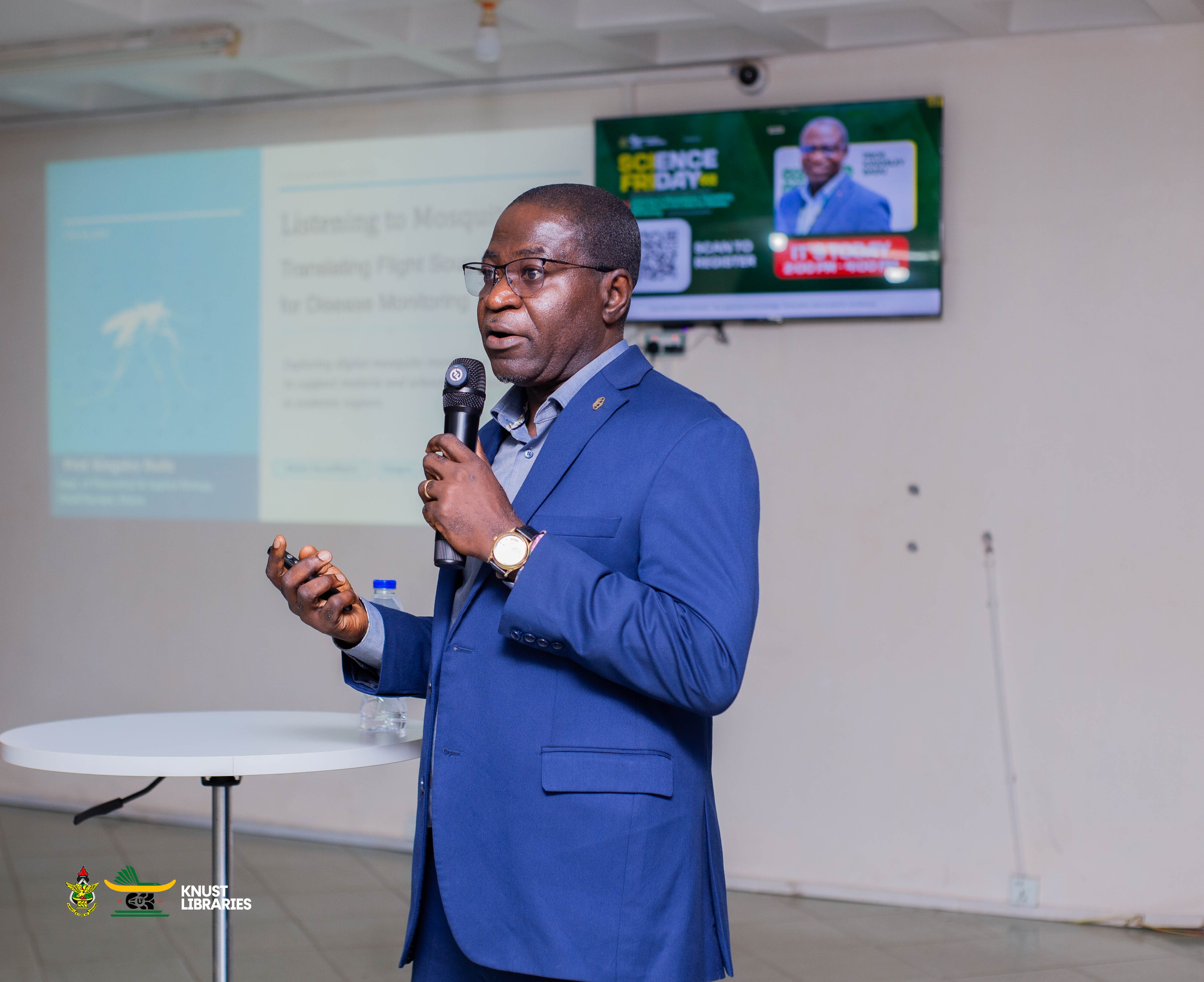
Prof. Kingsley Badu
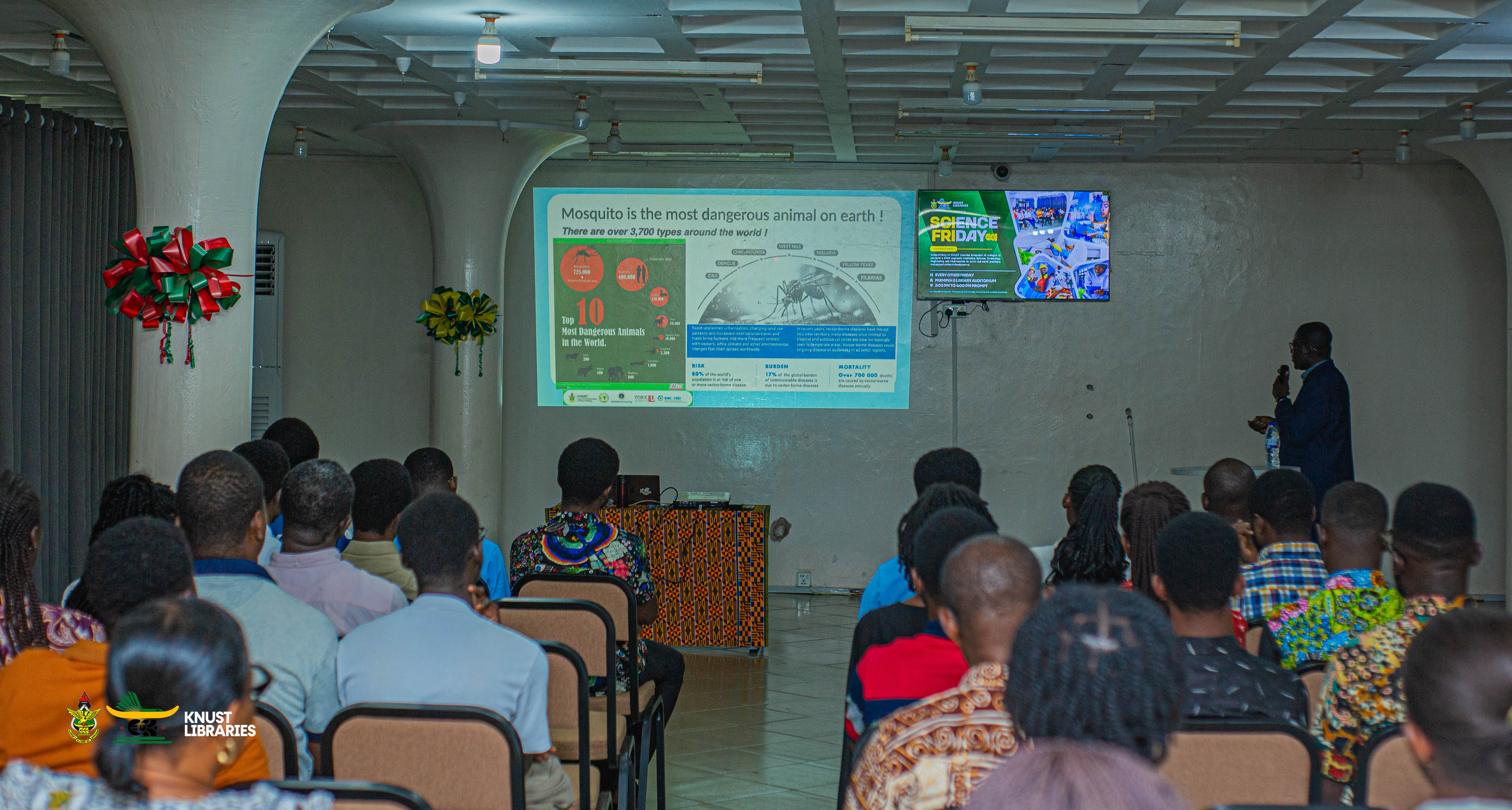
According to him, the mosquito, responsible for over 700,000 deaths annually from diseases like malaria, dengue, and Zika, is the world’s deadliest animal. Traditional mosquito surveillance methods—such as human landing catches, CDC light traps, and microscopic identification—are labor-intensive, slow, and inadequate for real-time public health response. To address this, Professor Kinsley Bedu and his team at AI4PEP Ghana have developed an innovative, AI-driven mosquito surveillance system that leverages bioacoustics, edge computing, IoT, and machine learning to transform mosquito flight sounds and images into actionable data for disease monitoring.
The system captures the unique wingbeat frequencies of mosquitoes, which vary by species, sex, age, and physiological state, enabling real-time classification with 92–93% accuracy. Using high-quality microphones in soundproof environments, the team records flight tones and trains convolutional neural networks (CNNs) to analyze spectrograms of these sounds. The AI model is compressed using TinyML to run directly on low-power edge devices deployed in mosquito traps, allowing on-device classification without cloud dependency. These devices also collect environmental data—temperature, humidity, GPS—and transmit summarized results wirelessly to a centralized dashboard.
Complementing the acoustic system is Mosque Mesa Net, a mobile app developed by computer scientist Alice that uses computer vision to identify mosquito species from photos with up to 99.37% accuracy. Notably, it can identify not only adult mosquitoes but also aquatic stages—eggs, larvae, and pupae—enabling early intervention. Designed for citizen science, the app empowers communities, especially in remote areas, to contribute to surveillance using widely available smartphones.
The real-time dashboard provides public health officials with interactive maps showing device locations, mosquito counts by species, sex, and age, environmental conditions, and device status. This enables targeted interventions such as spraying or bed net distribution and supports integration with national health systems. The team is working to synchronize the system with the Ghana Health Service’s database for seamless data sharing.
Community engagement has been vital, revealing concerns about tiny, non-mosquito biting insects that were found to contain blood, prompting expanded research. The project also prepares for emerging threats like the invasive Anopheles stephensi, training AI models to recognize new species via image and sound data.
Internationally recognized, the project has presented at global forums including the UNGA Science Summit and the 8th Global Symposium on Health Systems Research. Field testing is underway in the Philippines to enhance model generalizability across Africa and Asia. Funded by IDRC Canada, FCDO UK, NIH, and others with over $3 million, the initiative has received multiple awards, including KNUST’s best innovation and multidisciplinary awards.
Future goals include detecting viral pathogens directly from sound or in-trap molecular probes, scaling device deployment, publishing research on transmission dynamics, and exploring AI-based detection of insecticide resistance through wingbeat analysis. With mobile penetration exceeding 100% in Ghana, the potential for widespread adoption and impact on global health is significant, aiming to shift from reactive to predictive disease control through intelligent, automated surveillance.
The mosquito, responsible for over 700,000 deaths annually from diseases like malaria, dengue, and Zika, is the world’s deadliest animal. Traditional mosquito surveillance methods—such as human landing catches, CDC light traps, and microscopic identification—are labor-intensive, slow, and inadequate for real-time public health response. To address this, Professor Kinsley Bedu and his team at AI4PEP Ghana have developed an innovative, AI-driven mosquito surveillance system that leverages bioacoustics, edge computing, IoT, and machine learning to transform mosquito flight sounds and images into actionable data for disease monitoring.
The system captures the unique wingbeat frequencies of mosquitoes, which vary by species, sex, age, and physiological state, enabling real-time classification with 92–93% accuracy. Using high-quality microphones in soundproof environments, the team records flight tones and trains convolutional neural networks (CNNs) to analyze spectrograms of these sounds. The AI model is compressed using TinyML to run directly on low-power edge devices deployed in mosquito traps, allowing on-device classification without cloud dependency. These devices also collect environmental data—temperature, humidity, GPS—and transmit summarized results wirelessly to a centralized dashboard.
Complementing the acoustic system is Mosque Mesa Net, a mobile app developed by computer scientist Alice that uses computer vision to identify mosquito species from photos with up to 99.37% accuracy. Notably, it can identify not only adult mosquitoes but also aquatic stages—eggs, larvae, and pupae—enabling early intervention. Designed for citizen science, the app empowers communities, especially in remote areas, to contribute to surveillance using widely available smartphones.
The real-time dashboard provides public health officials with interactive maps showing device locations, mosquito counts by species, sex, and age, environmental conditions, and device status. This enables targeted interventions such as spraying or bed net distribution and supports integration with national health systems. The team is working to synchronize the system with the Ghana Health Service’s database for seamless data sharing.
Community engagement has been vital, revealing concerns about tiny, non-mosquito biting insects that were found to contain blood, prompting expanded research. The project also prepares for emerging threats like the invasive Anopheles stephensi, training AI models to recognize new species via image and sound data.
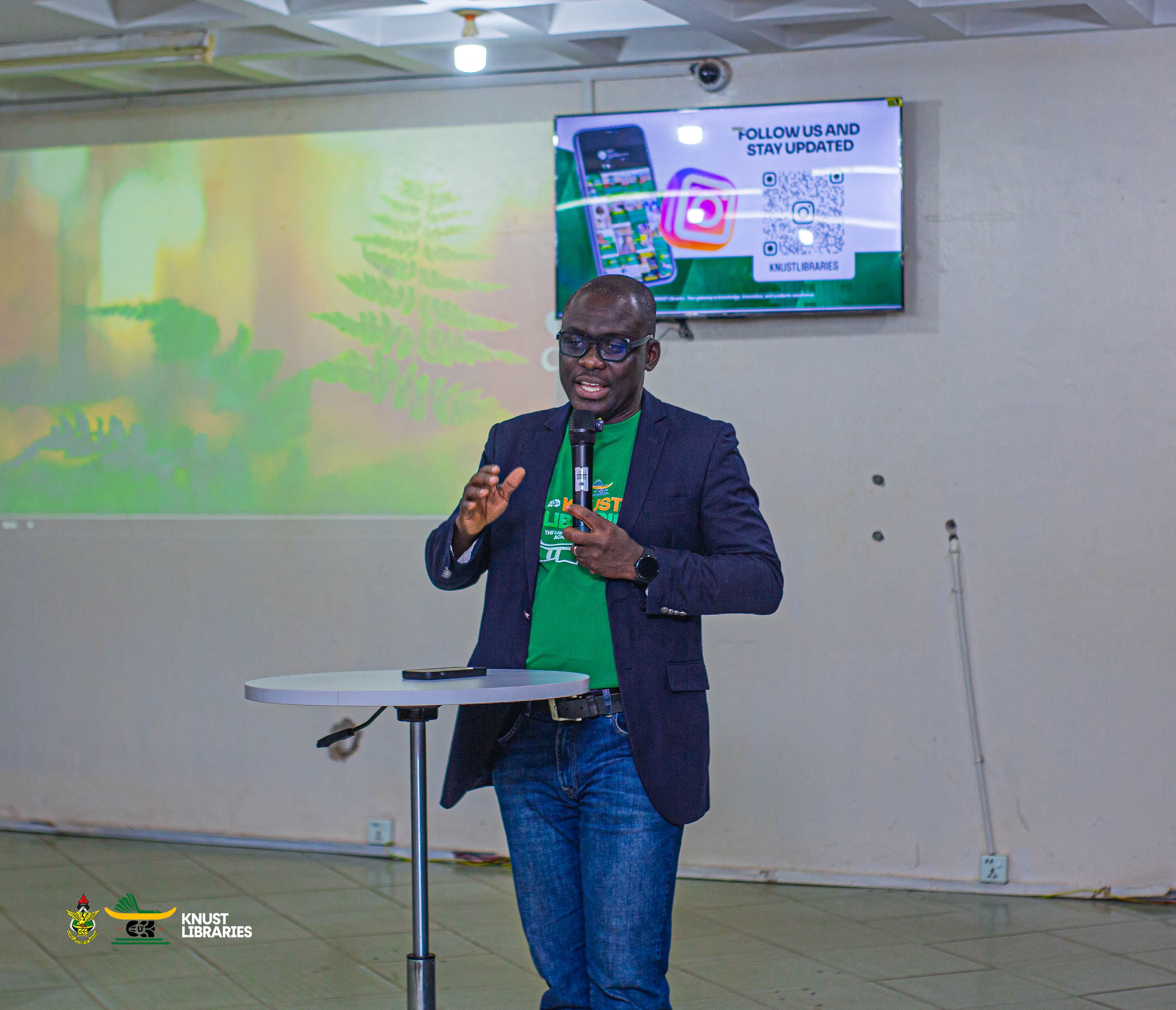
Dr Richard Bruce Lamptey (University Librarian )
Internationally recognized, the project has presented at global forums including the UNGA Science Summit and the 8th Global Symposium on Health Systems Research. Field testing is underway in the Philippines to enhance model generalizability across Africa and Asia. Funded by IDRC Canada, FCDO UK, NIH, and others with over $3 million, the initiative has received multiple awards, including KNUST’s best innovation and multidisciplinary awards.
Future goals include detecting viral pathogens directly from sound or in-trap molecular probes, scaling device deployment, publishing research on transmission dynamics, and exploring AI-based detection of insecticide resistance through wingbeat analysis. With mobile penetration exceeding 100% in Ghana, the potential for widespread adoption and impact on global health is significant, aiming to shift from reactive to predictive disease control through intelligent, automated surveillance.